


Profitability Index
Profitability index (PI) is the ratio of investment to pay off a suggested project. It is a useful capital budgeting technique for grading projects because it measures the value created per unit of investment made by the investor.
This technique is also known as Profit Investment Ratio (PIR), Benefit-Cost Ratio and Value Investment Ratio (VIR).
The ratio is calculated as follows:
Profitability Index formula
Profitability Index = Present Value of Future Cash Flows / Initial Investment
If the project has positive NPV, then the PV of future cash flows must be higher than the initial investment. Thus the Profitability Index for a project with positive NPV is greater than 1 and less than 1 for a project with negative NPV.
This technique may be used when available capital is limited and we can allocate funds to projects with the highest PIs.
Profitability Index Decision Rule:
Rules for the selection or rejection of a proposed project:
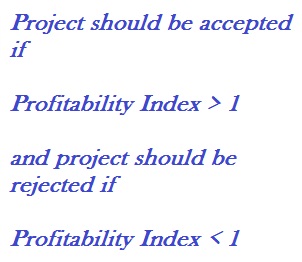
Project should be accepted if
Profitability Index > 1
and the project should be rejected if
Profitability Index < 1
nice information
easy to understand the concepts of capital budgeting
worthfull and easy to understand
Thanks
yes. good info n easy too…………